

Written by:
·
Reading time:
minutes
One of the most important tools I’ve found for working with emotions is the Emotional Freedom Technique (EFT).
When I first tried it, it sounded completely bizarre and didn’t do much for me. It was years later when working with my therapist that it clicked, and since then it’s been indispensable.
Below is the version I use myself. There are many alternatives and I’d encourage you to experiment and adapt it to suit you.
What is EFT?
EFT is a way of connecting into the emotions and sensations in our body - particularly those that are stuck or causing us distress - and helping them process and be released.
It involves tapping on acupuncture points on the face and body whilst describing these feelings out loud. I think of it like tapping on a blocked pipe to help shift trapped emotions and let them flow through.
For example, we might be feeling a persistent pressure in our chest, which for us is a symptom of anxiety. EFT helps us work with this sensation and often ease it or change how we are in relation to it.
EFT doesn’t get rid of emotions - that’s not the aim, even though we may strongly desire to not be feeling the way we do. Instead, we’re being present with what’s actually happening for us in our body. By acknowledging, accepting and really feeling our feelings, we allow them to be heard, which allows them to move on.
How to do EFT
The process is:
- Say the acceptance statement out loud, three times.
- Tap on each acupuncture point in turn, whilst repeating the issue statement out loud
- Pause for a few breaths
Repeat the tapping and pause (parts 2 and 3) 3 or more times.
Acceptance statement
Start by identifying the emotion, sensation or memory you’re working with, including locating it in your body if possible. For example, ‘this anxiety in my chest’ or ‘this dull pain in my gut’.
This is your issue statement, which names the thing you’re focusing on. Add this into the acceptance statement below:
“Even though I have [issue], I accept myself”
E.g. “Even though I have this anxiety in my chest, I accept myself”
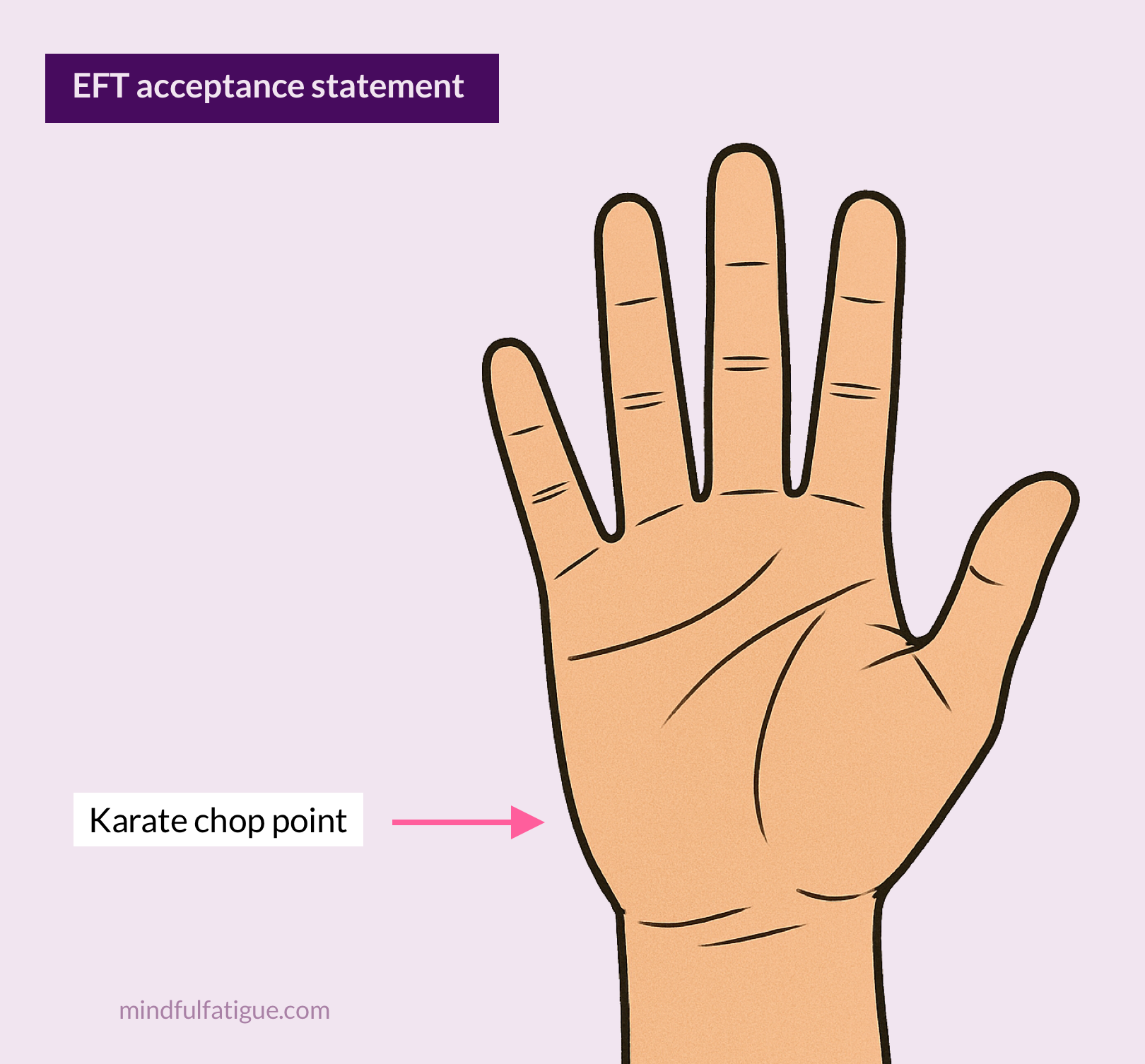
Repeat this out loud three times whilst tapping your fingers on the ‘karate chop point’ on the side of your other hand, about a third of the way up from your wristbone towards the base of your little finger (see diagram below).
Tap on the points
Now, tap with one hand on the acupuncture points below whilst repeating the issue statement out loud.
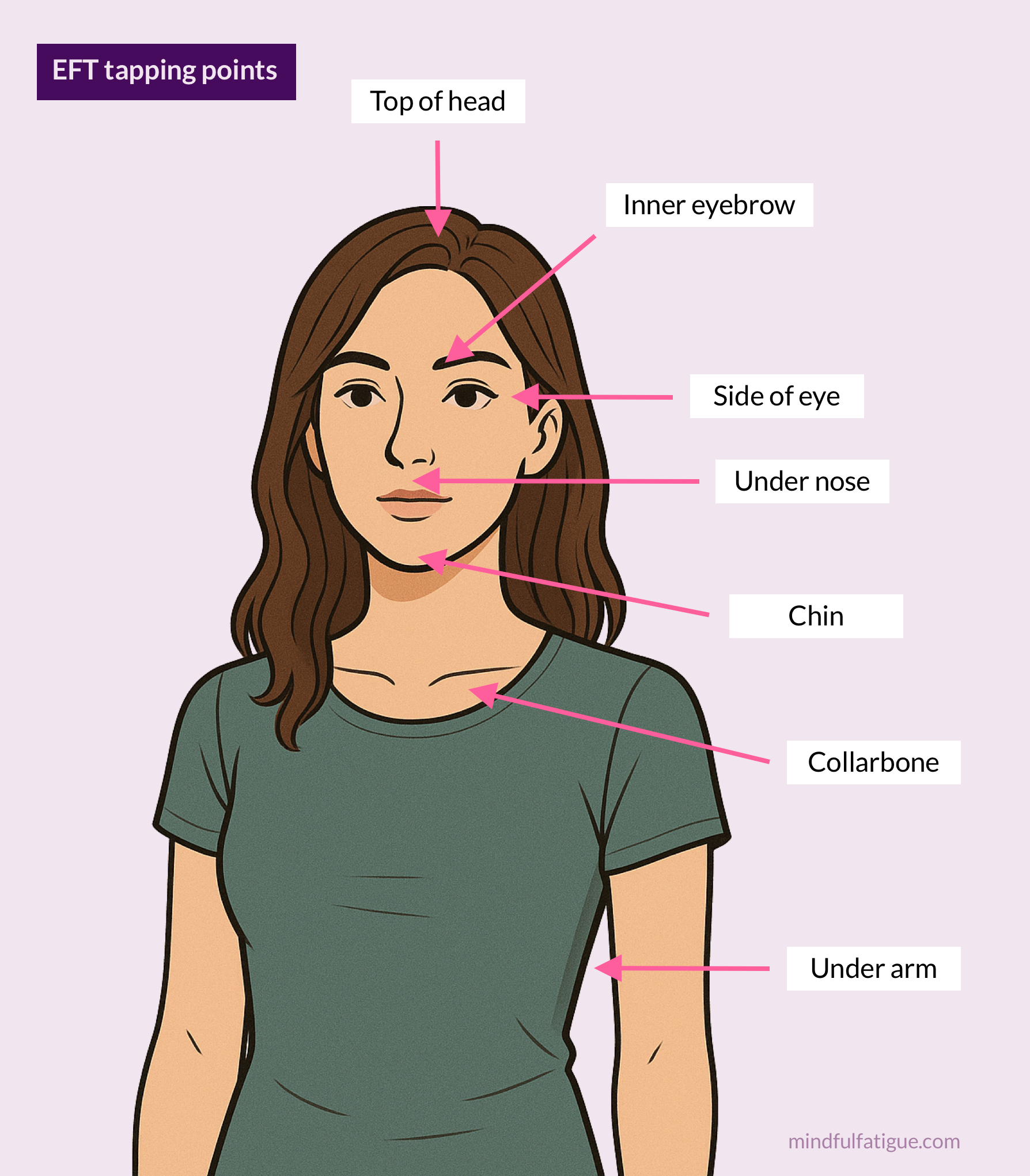
The tapping points, in order, are:
- Inner eyebrow
- Side of eye
- Under eye
- Under nose / above lip
- Chin
- Collarbone
- Under arm/side body (about 10cm under the armpit)
- Top of head
See the diagram below for a visual guide.
Follow the order of points as given above. Aim to tap around 7-8 times on each point, but don’t worry too much about the exact number. Tap gently but clearly - we’re not attacking ourself, but each tap should be noticeable.
Whilst tapping on each point, feel into the issue whilst repeating the issue statement out loud. For example, feel the sensations in your chest whilst saying out loud ‘this anxiety in my chest’.
Allow space for the issue statement to develop as you feel into it, by describing what feels true for you in that moment. E.g. ‘this anxiety in my chest’, ‘it feels crushing’, ‘i’m sick of this feeling’, ‘it’s really intense’, ‘it comes in waves’.
It’s enough for one short sentence on each point - don’t try to rush out everything at once, allow time for the feelings to release at their own speed. If nothing changes, just stick with the initial statement.
Once you’ve finished all 8 tapping points, pause and take a few slow breaths. Then, repeat the tapping and issue statement cycle again, with another pause at the end.
There’s no need to repeat the initial acceptance statement again.
Generally, 3 full cycles is a good amount for a short EFT session, but you can do as many as you like if you feel it’s helping. It can take time for emotions to start to shift, so be patient and kind with yourself. For more challenging emotions and particularly for traumatic memories, significantly longer sessions can be very beneficial, or multiple sessions over time.